
Stained Glass Windows
Best for:
Art printsDesktop wallpapersSocial media postsWindow mockupsGreeting cardsLogo conceptsPhone wallpapers
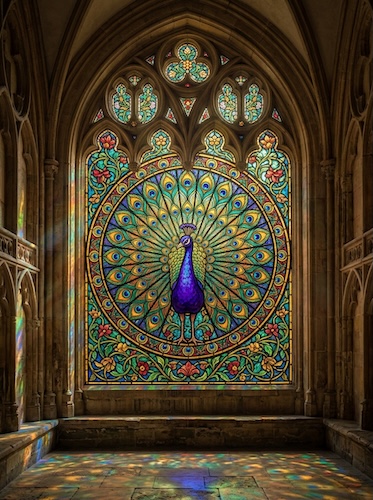
Sample prompt used to generate the hero image
Stained glass window depicting a peacock with tail feathers fully displayed, in the Gothic cathedral rose window tradition, 3:4 vertical format. Bold black lead lines (cames) separate each piece of translucent colored glass. Jewel-toned glass — sapphire blue, emerald green, ruby red, amethyst purple, and amber gold. Bright white light streams through from behind, illuminating every piece and creating a luminous glow. Visible glass texture — slight variations in thickness, tiny bubbles, and color density. Geometric organization within organic forms. The peacock's tail radiates outward like a mandala.Prompt Variations
Section titled “Prompt Variations”Stained glass [ANIMAL], bold lead lines, jewel-toned glass, backlit glow, visible glass texture, Gothic/Art Nouveau style, [FORMAT].Circular rose window with radial symmetry, geometric patterns, jewel tones, lead lines, backlit, Gothic cathedral, [FORMAT].Stained glass [SCENE], lead-line segmented, translucent jewel glass, backlit glow, visible texture, [FORMAT].Stained glass portrait of [SUBJECT], bold lead lines simplifying features, jewel tones, backlit glow, [FORMAT].Art Nouveau Tiffany-style stained glass of [SUBJECT], flowing organic lead lines, opalescent glass, warm backlight, [FORMAT].Create a stained glass window depicting [ANIMAL] in the Gothic cathedral tradition — bold black lead lines (cames) separating jewel-toned translucent glass pieces in sapphire, emerald, ruby, amethyst, and amber. Bright white light streams through from behind, illuminating every piece. Visible glass texture with thickness variations and tiny bubbles. 3:4 vertical format.Create a circular Gothic rose window with perfect radial symmetry — geometric patterns of jewel-toned glass separated by bold lead lines, backlit with bright light, [CENTRAL MOTIF] at the center. 1:1 square format.Create an Art Nouveau Tiffany-style stained glass panel of [SUBJECT] — flowing organic lead lines, opalescent and iridescent glass, warm backlight glow, botanical framing. 3:4 vertical format.stained glass window of [ANIMAL], bold black lead lines, jewel-toned translucent glass, sapphire emerald ruby amber, backlit glow, visible glass texture, Gothic cathedral --ar 3:4 --s 300circular Gothic rose window, radial symmetry, geometric jewel-toned glass, bold lead lines, backlit, [CENTRAL MOTIF] --ar 1:1 --s 250Art Nouveau Tiffany stained glass of [SUBJECT], flowing organic lead lines, opalescent glass, warm backlight, botanical framing --ar 3:4 --s 350stained glass window, [ANIMAL], bold black lead lines, jewel-toned translucent glass, sapphire emerald ruby amethyst amber, backlit glow, visible glass texture, Gothic cathedral styleNegative Prompt
flat illustration, no lead lines, opaque colors, photograph, low qualitycircular Gothic rose window, radial symmetry, geometric stained glass patterns, jewel tones, bold lead lines, bright backlight, [CENTRAL MOTIF]Negative Prompt
asymmetric, flat colors, painting, photograph, blurImage-to-Image Transformations
Section titled “Image-to-Image Transformations”Using the attached photo, recreate the subject as a stained glass window. Divide all forms into segments separated by bold black lead lines. Fill each segment with translucent jewel-toned colored glass — assign colors based on the original image's palette. Add bright backlight streaming through, illuminating every piece. Visible glass texture — slight thickness variations and bubbles. Gothic/Art Nouveau style.[Upload Photo] "Recreate this subject as a stained glass window — segment all forms with bold black lead lines, fill with translucent jewel-toned glass based on the original palette, add bright backlight glow and visible glass texture with bubbles and thickness variations."[IMAGE_URL] stained glass window, bold black lead lines, jewel-toned translucent glass, backlit glow, visible glass texture, Gothic style --iw 1 --ar 3:4Tips & Best Practices
Section titled “Tips & Best Practices”- Lead lines = bold black cames: Without visible lead lines separating glass pieces, it’s just a colorful illustration.
- Backlight is essential: Stained glass is meant to be illuminated from behind. Without backlight, the colors don’t glow.
- Jewel tones only: Sapphire, emerald, ruby, amethyst, amber — stained glass uses deep, saturated, translucent colors.
- Glass texture: “Slight variations in thickness, tiny bubbles, color density” authenticates the glass medium.
- Pairs well with: Paper Cutout / Kirigami (similar light-through-material), Art Deco Illustration (similar geometric beauty)