
Double Exposure
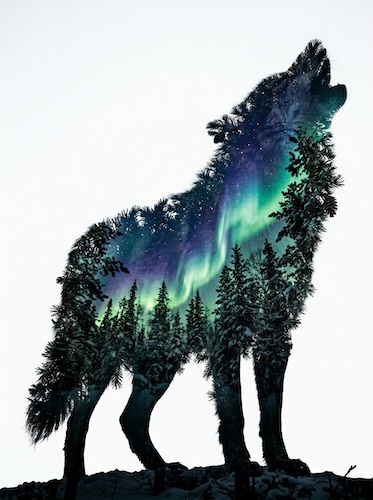
Best for:
Profile picturesAlbum coversSocial media postsArt printsMovie postersBook coversEditorial illustrations
Sample prompt used to generate the hero image
Double exposure photograph merging a side-profile silhouette of a woman with an autumn forest landscape, 3:4 vertical format. The darkest areas of the silhouette — hair, jawline, shoulder — reveal dense golden and crimson autumn foliage. The lighter skin areas blend with the soft misty sky visible between the trees. The silhouette's outline is crisp and recognizable against a clean white background. Warm amber and gold color palette. The two images blend seamlessly — neither dominates, they coexist as a single unified composition.Prompt Variations
Section titled “Prompt Variations”Double exposure photograph merging a [ANGLE — e.g., side-profile / front-facing / three-quarter] silhouette of [SUBJECT] with [LANDSCAPE — e.g., a misty mountain forest at sunrise], [FORMAT]. The darkest areas of the silhouette reveal [NATURE DETAILS — e.g., dense pine trees and rocky peaks]. Lighter areas blend with the sky. Crisp silhouette outline against a clean [BACKGROUND — e.g., white / black] background. [COLOR PALETTE — e.g., cool greens and misty blues]. Seamless blend — neither image dominates.Double exposure photograph merging a [ANGLE] silhouette of [SUBJECT] with [CITYSCAPE — e.g., the New York skyline at golden hour with the sun setting between skyscrapers], 3:4 vertical format. The buildings and light emerge through the dark areas of the silhouette. Warm urban colors — [PALETTE]. Clean white background. The city and the person are one — a visual metaphor for urban identity.Double exposure photograph merging a [ANGLE] silhouette of [SUBJECT] with [TEXTURE — e.g., swirling galaxies, nebulae, and star fields], 1:1 square album cover format. The cosmic texture fills the silhouette entirely — stars visible in the hair, nebula colors across the face. The silhouette outline is crisp against pure black. [PALETTE — e.g., deep indigo, violet, and bright stellar whites]. The subject becomes the universe. Contemplative, cosmic, infinite.Double exposure merging the silhouette of [ANIMAL — e.g., a wolf howling] with [ENVIRONMENT — e.g., a winter pine forest under a full moon], 16:9 landscape format. The forest fills the animal's body — trees visible through the fur, moon positioned inside the head. The silhouette outline is crisp against [BACKGROUND]. [PALETTE]. Neither image dominates — they fuse into a single unified composition. The animal IS its habitat.Triple exposure photograph layering three elements: [ELEMENT 1 — e.g., a ballet dancer in mid-leap], [ELEMENT 2 — e.g., scattered rose petals], and [ELEMENT 3 — e.g., soft window light with curtain shadows], 3:4 vertical format. The dancer's silhouette is filled with rose petals, while the window light creates atmospheric depth across the entire image. [PALETTE — e.g., soft pinks, warm whites, and golden light]. Ethereal, layered, dreamlike. The three exposures create a visual poem.Create a double exposure photograph merging the silhouette of [SUBJECT] with [LANDSCAPE]. The dark areas of the portrait reveal the landscape; lighter areas blend into the background. Crisp silhouette outline on a clean [BACKGROUND]. [PALETTE]. Seamless, poetic blend. 4:5 vertical format.Create a double exposure of a [ANIMAL] silhouette filled with [ENVIRONMENT — e.g., misty pine forest]. Crisp outline, seamless internal blend, [PALETTE]. 16:9 landscape format.Create a triple exposure layering [ELEMENT 1], [ELEMENT 2], and [ELEMENT 3] — layered, ethereal, dreamlike, the three exposures forming a visual poem. 3:4 vertical format.double exposure, [SUBJECT] silhouette filled with [LANDSCAPE], crisp outline, clean [BACKGROUND], [PALETTE], seamless blend --ar 4:5 --s 250double exposure, [ANIMAL] silhouette filled with [ENVIRONMENT], seamless blend, crisp outline, [PALETTE] --ar 16:9 --s 250triple exposure, [ELEMENT 1], [ELEMENT 2], [ELEMENT 3], layered ethereal dreamlike, visual poem --ar 4:5 --s 350double exposure photograph, [SUBJECT] silhouette, filled with [LANDSCAPE], crisp outline, clean [BACKGROUND], [PALETTE], seamless blendNegative Prompt
collage, separate images, harsh edges, cartoon, low qualitydouble exposure, [ANIMAL] silhouette, filled with [ENVIRONMENT], seamless poetic blend, crisp outline, [PALETTE]Negative Prompt
collage, separate images, harsh edges, cartoon, digital artifactsImage-to-Image Transformations
Section titled “Image-to-Image Transformations”Using the attached portrait photo, create a double exposure effect by blending the subject's silhouette with [SECOND IMAGE — e.g., an autumn forest / city skyline / ocean waves]. The darkest areas of the portrait should reveal the second image. Lighter areas blend with the sky/background of the second image. Maintain a crisp silhouette outline. Clean [white/black] background outside the silhouette. [PALETTE].[Upload Photo] "Create a double exposure from this portrait — blend the silhouette with [SECOND IMAGE], letting the dark areas reveal the second scene, keep a crisp outline and a clean background outside the silhouette."[IMAGE_URL] double exposure, silhouette blend with [SECOND IMAGE], crisp outline, clean background, seamless --iw 1.2 --ar 4:5Tips & Best Practices
Section titled “Tips & Best Practices”- Side-profile works best: The recognizable shape of a side-profile creates the strongest silhouette for the second image to fill.
- Contrast is the mechanism: The dark areas of image 1 reveal image 2. Choose subjects with clear dark/light separation.
- Clean background: White or black backgrounds outside the silhouette prevent visual clutter.
- Metaphor matters: The best double exposures create meaning — a person + their city = urban identity. A wolf + forest = wild nature. Choose pairings with intent.
- Common pitfalls: Don’t place two busy images together — one should be a simple silhouette, the other a landscape/texture.
- Pairs well with: Cloud / Smoke Sculpture (similar form-in-substance concept), Vinyl Album Cover (double exposure is a popular album cover technique)