
Superhero Comic Book
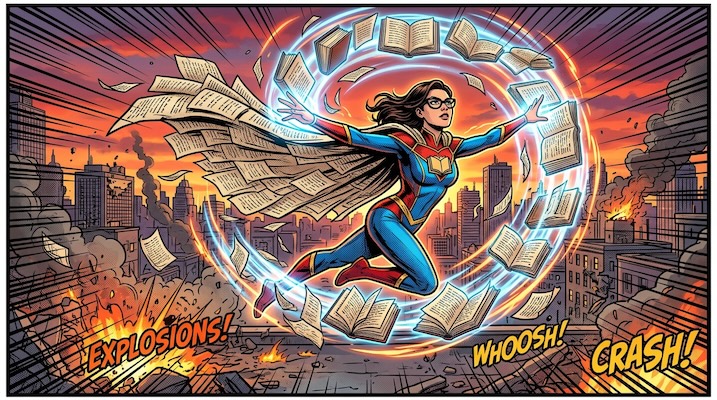
Best for:
Social media postsProfile picturesCharacter designsPoster printsBirthday invitationsFan art
Sample prompt used to generate the hero image
Comic book panel illustration of a caped superhero landing with a fist slamming into cracked pavement, dynamic low camera angle looking up, 16:9 landscape format. Heavy black ink outlines on every form. Classic halftone dot shading in the shadows. Radiating speed lines and impact debris exploding outward from the landing point. Bold primary colors — red cape, blue suit, gold emblem. The word "KRAKOOM!" in jagged stylized comic lettering above the figure. Dramatic foreshortened fist in the foreground. Urban skyline in the background with ink crosshatching on the buildings.Prompt Variations
Section titled “Prompt Variations”Comic book cover illustration of [SUBJECT — e.g., an armored warrior queen standing atop a cliff with her sword raised against a stormy sky], 3:4 vertical cover format. Heavy black ink outlines on every form. Classic halftone dot shading in the shadows and mid-tones. Bold primary color palette — [COLORS]. Dramatic low camera angle looking up at the figure. Wind-swept cape/hair adding dynamic motion. Title banner area at the top. Classic Marvel/DC Silver Age comic book aesthetic.Comic book action panel of [SUBJECT] in a dynamic mid-combat pose — [ACTION — e.g., throwing a massive energy punch that shatters the ground], 16:9 landscape format. Heavy black ink outlines. Halftone dot shading. Radiating speed lines and impact debris. Dramatic foreshortening on the leading fist/foot. Onomatopoeic sound effect text — "[SOUND — e.g., KRAKOOM!]" — in bold jagged comic lettering. Bold primary colors. Urban/dramatic [ENVIRONMENT] background with ink crosshatching.Comic book character design sheet for [CHARACTER — e.g., a cybernetic ninja with a glowing visor and retractable arm blades], white background, 16:9 landscape format. Three views side by side: front-facing, three-quarter view, and rear view. Heavy black ink outlines. Flat comic book coloring with halftone dot shading on the shadows. Each view shows the full body with consistent proportions and costume detail. Small annotation arrows pointing to key design elements with brief text labels. Professional character reference sheet aesthetic.Comic book panel sequence showing an origin story in three horizontal panels stacked vertically, 9:16 vertical format. Panel 1: [ORDINARY MOMENT — e.g., a scientist working late in a lab], low-key lighting, muted colors. Panel 2: [TRANSFORMATION — e.g., an explosion bathes them in radiant energy], intense color burst, speed lines. Panel 3: [HERO REVEALED — e.g., they stand transformed in a new suit with powers manifesting], dramatic heroic pose, bold colors. Heavy black ink outlines. Halftone shading. Classic comic book narrative flow.Comic book portrait of a menacing villain — [CHARACTER — e.g., a shadow sorcerer with a cracked obsidian mask, glowing violet eyes, and tendrils of dark energy swirling from their hands], 3:4 vertical format. Heavy black ink outlines with extra-thick lines on the silhouette. Deep shadows with halftone dot shading. Limited color palette — predominantly dark tones ([DARK COLOR]) with a single piercing accent color ([ACCENT COLOR]) on the eyes/energy. Dramatic overhead lighting casting the face half in shadow. Crosshatched background. Menacing, imposing composition.Create a comic book cover illustration of [SUBJECT] in a dramatic heroic pose with a stormy [ENVIRONMENT] background. Heavy black ink outlines. Classic halftone dot shading. Bold primary colors. Low camera angle. Wind-swept cape. Silver Age Marvel/DC aesthetic. 2:3 vertical format.Create a comic book action panel of [SUBJECT] mid-combat: [ACTION]. Heavy ink outlines, halftone shading, speed lines, impact debris, onomatopoeic "[SOUND]" text in jagged lettering. Bold colors. Dramatic foreshortening. 3:2 landscape format.Create a comic book character design sheet for [CHARACTER]: front, three-quarter, and rear views side by side on a white background. Heavy ink outlines, flat colors, halftone shading. Annotation labels pointing to key design elements. 3:2 landscape format.Comic book cover, [SUBJECT] in heroic pose, heavy black ink outlines, halftone dot shading, bold primary colors, dramatic low angle, wind-swept cape, Silver Age aesthetic --ar 2:3Comic book action panel, [SUBJECT] mid-combat [ACTION], heavy ink outlines, halftone shading, speed lines, impact debris, onomatopoeia text, bold colors, dramatic foreshortening --ar 16:9Comic book villain portrait, [CHARACTER], heavy ink outlines, deep shadows, halftone dots, limited dark palette with [ACCENT COLOR] eyes, dramatic overhead lighting, menacing --ar 4:5Comic book cover illustration, [SUBJECT] in heroic pose, heavy black ink outlines, halftone dot shading, bold primary colors, dramatic low angle, Silver Age Marvel DC aestheticNegative Prompt
photograph, realistic, 3d render, smooth gradient, anime, watercolorComic book action panel, [SUBJECT] mid-combat, heavy ink outlines, halftone shading, speed lines, impact debris, sound effect text, bold colors, foreshorteningNegative Prompt
photograph, realistic, soft, pastel, anime, watercolorComic book character design sheet, [CHARACTER], front and side views, white background, heavy ink outlines, flat colors, halftone shading, annotation labelsNegative Prompt
photograph, realistic, 3d, gradient shading, single viewImage-to-Image Transformations
Section titled “Image-to-Image Transformations”Using the attached photo as reference, transform the subject into a comic book superhero illustration. Preserve their face shape, hairstyle, and build, but render everything with heavy black ink outlines, halftone dot shading, and bold primary colors. Give them a heroic costume: [COSTUME DESCRIPTION — e.g., a red and gold suit with a star emblem]. Add dramatic comic book lighting — strong key light with deep ink shadows. Place against an action-oriented [ENVIRONMENT] background with crosshatching.[Upload Photo] "Transform this person into a comic book superhero. Give them a heroic costume of [DESCRIPTION]. Preserve their face shape and hairstyle. Heavy black ink outlines, halftone dot shading, bold primary colors. Dramatic action pose. Comic book panel aesthetic."[IMAGE_URL] Comic book superhero style, heavy ink outlines, halftone dot shading, bold primary colors, heroic costume, dynamic pose, dramatic lighting --iw 1.5 --ar 4:5Tips & Best Practices
Section titled “Tips & Best Practices”- Halftone dots are the signature: “Classic halftone dot shading” is what separates comic book art from generic illustration. Always include it.
- Name the era: “Silver Age Marvel/DC” produces classic bold heroics. “Modern Image Comics” produces darker, grittier results. “Golden Age” produces simpler, more wholesome compositions.
- Foreshortening adds power: “Dramatic foreshortening on the leading fist” or “low camera angle looking up” immediately adds dynamism.
- Onomatopoeia sells it: Adding “BOOM!”, “CRACK!”, or “WHOOSH!” in the prompt creates authentic comic book sound effects that cement the style.
- Common pitfalls: Avoid mixing “realistic” with comic book — it produces an awkward painted look. Don’t skip “heavy black ink outlines” — without them it looks like generic illustration.
- Pairs well with: Cell Shaded Art (similar bold outlines, different medium), Glitch Art (for cyberpunk-meets-comic mashups)